


Museum area
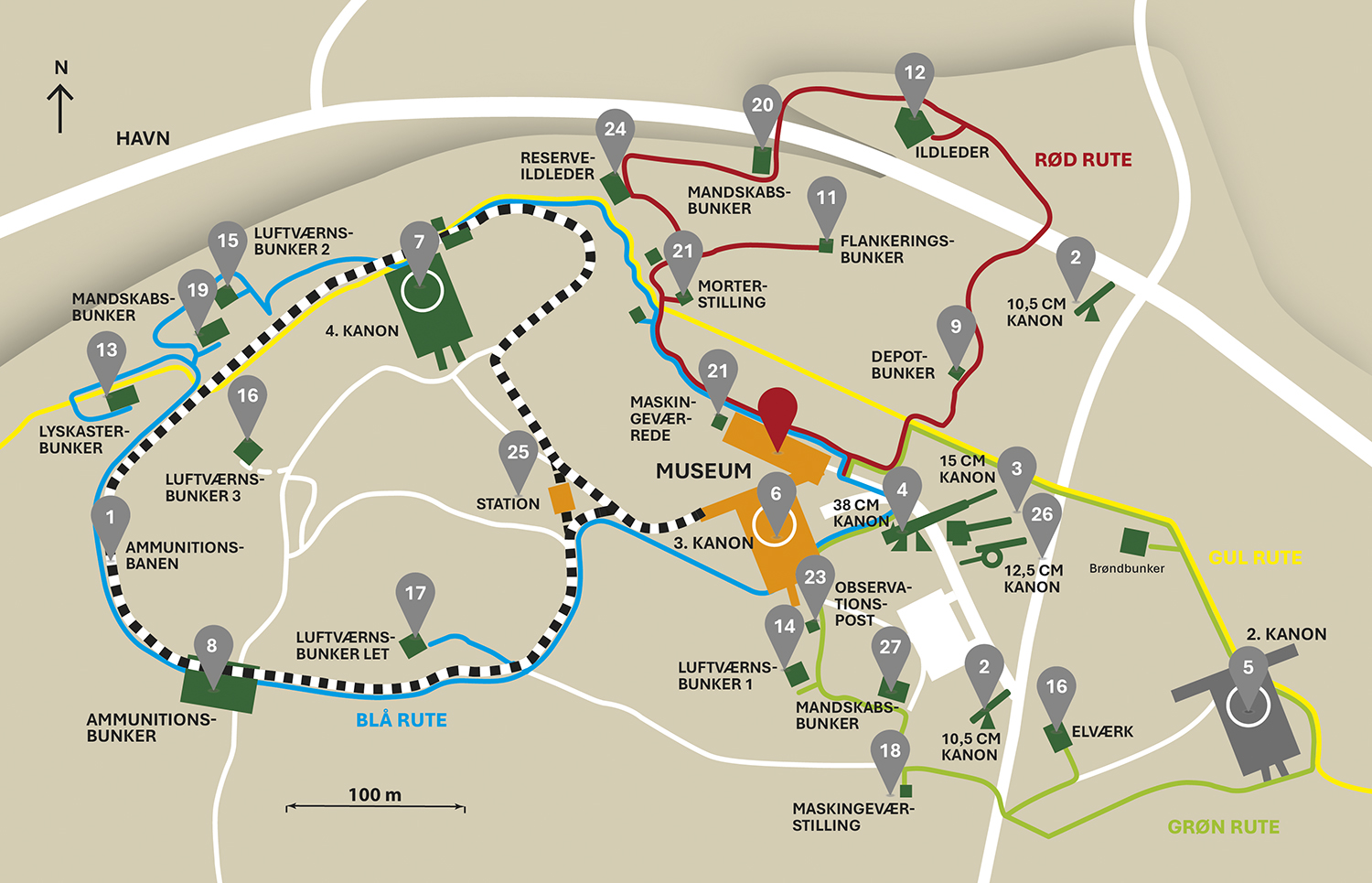
The unique open-air museum around the museum bunker and the bunker museum covers approximately 220,000m² and forms the western half of the German 38 cm battery.
During the war, the museum area was a bare and harsh dune landscape. In the early 1950s, however, the Danish government planted spruce trees to shelter the town of Hanstholm from the harsh climate of the west coast. They succeeded, and today we have a beautiful and varied dune forest.
In the area you can see some of the various bunkers that have been exposed in this part of the battery. Remember the flashlight!
Museum area
The unique open-air museum around the museum bunker and the bunker museum covers approximately 220,000m² and forms the western half of the German 38 cm battery.
During the war, the museum area was a bare and harsh dune landscape. In the early 1950s, however, the Danish government planted spruce trees to shelter the town of Hanstholm from the harsh climate of the west coast. They succeeded, and today we have a beautiful and varied dune forest.
In the area you can see some of the various bunkers that have been exposed in this part of the battery. Remember the flashlight!
The ammunition track was built because the ammunition for the 38 cm guns was too heavy to be carried around on a sack truck. Therefore, an approximately 4.3 km long narrow-gauge track was constructed within the battery area. Shells and powder charges were transported by small diesel locomotives to the four gun positions from six large ammunition bunkers located further back in the terrain.
See the museum train timetable.
In the museum terrain, part of the old ammunition track has been restored. With the museum train you can take a trip through the battery and pass through one of the large ammunition bunkers and one of the bunkers for the 38 cm cannon. The trip is just over 1 km long and takes about 10 minutes.
10.5 cm S.K.C/32. Combined anti-ship and anti-aircraft gun originally designed for use on light naval units, but also widely used in coastal defense.
The gun had a maximum range of 15,175 m and could fire up to 16 shots per minute. The shells weighed 15 kg.
In 1945, 16 cannons of this type were set up at Hanstholm.
German ship cannon of the type 15 cm S.K.C/28.
The cannon type was installed in many different types of lavettes. This gun is in a coastal artillery launcher model 1936, Küst MPL C/36. The gun type was designed by the German company Rheinmetall-Borsig, but this gun was produced at the Skoda factories in the Czech Republic and has production number 1457. This gun was installed in the fall of 1944 in a German coastal battery at Hesbjerg near Gilleleje in North Zealand.
FACTS
Model year: 1928
Weight of cannon in position: 19,661 kg
Length of gun barrel: 8.2 m
Range: 23,500 m.
Shell weight: 45 kg
Muzzle velocity: 875 m/s
Rate of fire: 6 shots per minute
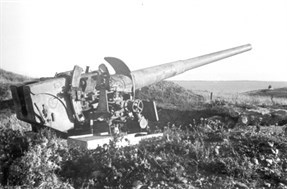
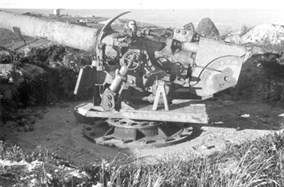
15 cm cannon on Fynshoved, photographed in August 1945.
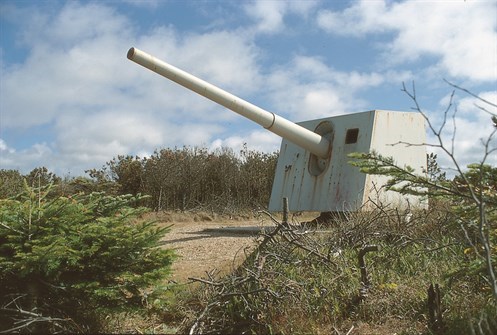
German ship cannon of the type 38 cm S.K.C/34. The gun type was designed for the German battleships of the "Bismarck" class.
The gun barrel is of the same type as the ones in the museum bunker.
Until May 2005, this gun barrel was located in the courtyard of the Tøjhus Museum in Copenhagen. The gun barrel should have been mounted in the German battery "Tirpitz" at Oksby, near Blåvand. However, the cannons were never mounted, so in May 1945, the gun barrels were stored at a storage site at Guldager Station near Esbjerg. In 1947, the gun barrels were transported to Copenhagen.
Originally, the gun tube had been manufactured to rearm the German battleship "Gneisenau", which had previously been equipped with 28 cm guns. However, the refitting was abandoned in February 1943 after the ship was severely damaged during an Allied bombing raid. Instead, the guns were used for coastal defense.
The gun barrel has the number "89" and was manufactured at the Krupp factory in Essen in 1943.
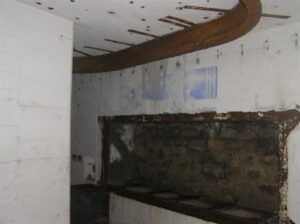
The second-easternmost of the 38 cm battery's four gun bunkers, gun no. 2, is located approximately 300 m east of the museum bunker. The bunker is identical to the museum bunker.
The bunker's gun emplacement was filled with earth in 1971. However, both the crew and ammunition parts of the bunker are still accessible.
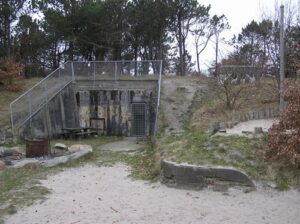
In the ammunition rooms, you can see well-preserved paintings of grenades and powder casings above the ammunition locks.
Don't forget your flashlight!
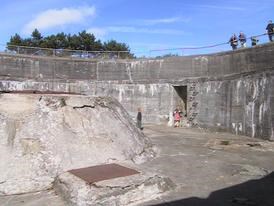
The museum bunker has a total area of approximately 2500 m2, making it one of the largest bunkers the Germans built in Denmark. In the center of the museum bunker stood one of the four 38 cm cannons that made up the German coastal battery.
The battery could launch its shells at a distance of 55 km. Together with a similar battery at Kristiansand in Norway, on the other side of the Skagerrak, the battery in Hanstholm would block the approximately 120 km wide waters between Denmark and Norway.
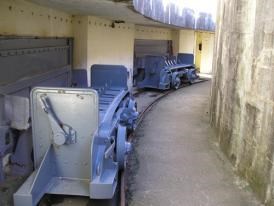
The bunker consists of three main parts: ammunition room, gun bay and crew and technical section.
The big gun has not been preserved, but some of the bunker's rooms have been restored and returned to their original appearance with original equipment. In the other rooms there are exhibitions that shed light on different topics.
The westernmost of the 38 cm battery's four gun bunkers, gun no. 4, is located approximately 250 m northwest of the museum bunker.
The bunker is completely identical to the museum bunker but is a ruin with no lights or fixtures, so don't forget your flashlight when exploring!
The entrance to the bunker's ammunition room. Beware: in the summer months the museum train runs here!
Bunker type Regelbau S 468 for 38 cm ammunition.
The bunker had the German building number 1100 M5 and was completed on November 4, 1943. 5,130m3 of reinforced concrete was used to build the bunker. The bunker's ceiling and walls are 3.5 meters thick, making it the strongest type of bunker built in Hanstholm.
The bunker has two floors. Grenades were stored on the upper floor and the ammunition track runs through this part of the bunker. The powder charges were stored in the lower floor of the bunker, where there were also heating and ventilation systems to ensure a stable and good climate in the bunker.
The bunker had room for 232 rounds of 38 cm ammunition.
In the fall of 1943, four bunkers of this type were built in the battery.
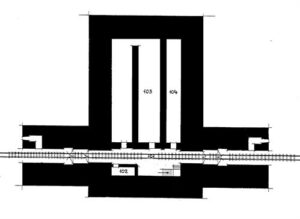
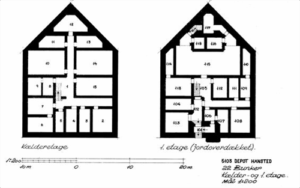
Floor plan of the top floor of the ammunition bunker.
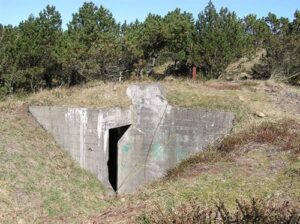
This simple bunker was probably the depot for the 38 cm battery's emergency rations and was probably built in 1941.
There was no kitchen in the four gun bunkers. Food for the battery's crew was prepared and partly consumed in a large canteen further up the road - now a district heating center. In the event of a battle, it was impossible to leave the battery and emergency rations were needed.
Power bunker to supply the 38 cm battery with power in case the supply from the civilian grid was interrupted.
The bunker had the German construction number 1100 MZ and has approximately 1 m thick walls and ceilings. Work on the bunker began in the summer of 1941, and in March 1942 it was largely completed, although in May 1942 the large generator had not yet been delivered.
The bunker contains an engine room, fuel room, cooling water room and ventilation room. In addition, the bunker contains a bedroom for three men.
In the bunker were two diesel generators, a large 200 hp and a smaller 56 hp - equivalent to the equipment in each of the four gun bunkers.
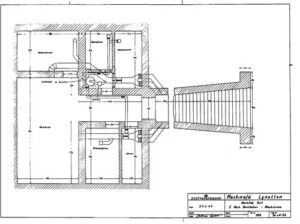
Floor plan, 1947.
Machine gun bunker, so-called "F-Stand", built in June 1944.
From the firing slit, the road leading up from the beach could be fired upon, thus protecting the battery from attack from this side. The sea-facing wall of the bunker is particularly thick and is extended like a trunk so that the firing slit was covered against fire from this side.
The only room in the bunker had a stove and bunk space for two men.
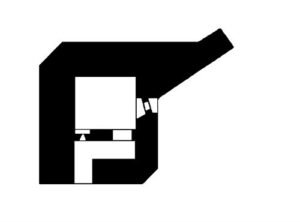
The 38 cm guns were controlled from the large fire control bunker located on the edge of Holmen, about 250 meters northeast of the museum bunker.
The bunker with the German construction number 1100 L has 1-2 m thick walls and ceilings. Work on the bunker began in February 1941, and in the second half of May the bunker was completed. However, the large bunker was not fully furnished until December 1941. Until then, the battery's firing was directed from a temporary fire control station, which was demolished at the same time as the large bunker was taken into use.
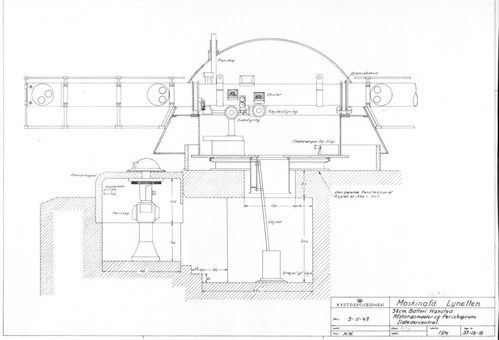
Sectional drawing of the front part of the fire control bunker with dome with rangefinder and dome with periscope.
The two-storey bunker had a 10.5 m long rangefinder on the roof of a large, rotating armored dome. On the top floor of the bunker was a calculation room where bearings and range measurements were converted into shot data. The lower floor of the bunker contained living quarters for the crew, showers and toilets.
The bunker is still accessible, but is separated from the museum area by Kaj Lindberggade, which was built in the 1960s. As the bunker is on two floors, great care should be taken when traveling in it.
A Regelbau L/411A floodlight garage for a 60 cm floodlight. The bunker was built in late summer 1943.
The searchlight was used for night air raids. The searchlight had to identify the aircraft for the three positions with 2 cm anti-aircraft guns that were located around the searchlight position. When there was an air raid, the searchlight was driven out of the garage and up the concrete track to a position up on the slope.
The bunker's garage room housed the searchlight and its diesel generator, which produced power for the searchlight. The bunker's crew room contained bunks for 6 men as well as a tiled stove and a hand-operated ventilation system.
Bunker of type Regelbau Fl. 242 for a 2.0 cm anti-aircraft gun.
The bunker had the German building number 1116 and was completed on June 4, 1943. 570 m3 of reinforced concrete was used to build the bunker. The bunker ceiling and walls are 2 m thick.
The bunker consists of an open breech on the roof where the anti-aircraft gun was set up. In the bunker there is a crew room with room for six men and an ammunition room.
The bunker was part of a platoon with a total of three anti-aircraft guns to protect 38 cm gun no. 3 - the current museum bunker - against attacks from low-flying aircraft. Each of the four 38 cm guns was protected by such a platoon of light anti-aircraft guns.
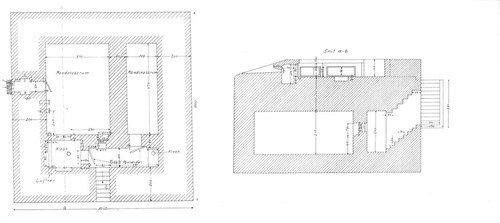
Ground plan and sectional drawing of anti-aircraft bunker of the type Regelbau Fl 242. Measured by the Coastal Defense 1947.
Bunker of type Regelbau Fl. 242 for a 2.0 cm anti-aircraft gun.
The bunker had the German building number 1135 and was completed on June 25, 1943. 570 m3 of reinforced concrete was used to build the bunker. The bunker ceiling and walls are 2 m thick.
The bunker consists of an open breech on the roof where the anti-aircraft gun was set up. In the bunker there is a crew room with room for six men and an ammunition room.
The bunker was part of a platoon with a total of three anti-aircraft guns to protect 38 cm gun no. 3 - the current museum bunker - against attacks from low-flying aircraft. Each of the four 38 cm guns was protected by such a platoon of light anti-aircraft guns.
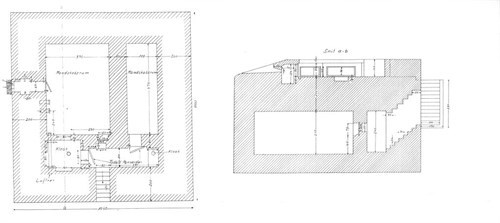
Ground plan and sectional drawing of anti-aircraft bunker of the type Regelbau Fl 242. Measured by the Coastal Defense 1947.
Bunker of type Regelbau Fl. 242 for a 2.0 cm anti-aircraft gun.
The bunker had the German building number 1134 and was completed on April 6, 1943. 570 m3 of reinforced concrete was used to build the bunker. The bunker ceiling and walls are 2 m thick.
The bunker consists of an open breech on the roof where the anti-aircraft gun was set up. In the bunker there is a crew room with room for six men and an ammunition room.
The bunker was part of a platoon with a total of three anti-aircraft guns to protect 38 cm gun no. 3 - the current museum bunker - against attacks from low-flying aircraft. Each of the four 38 cm guns was protected by such a platoon of light anti-aircraft guns.
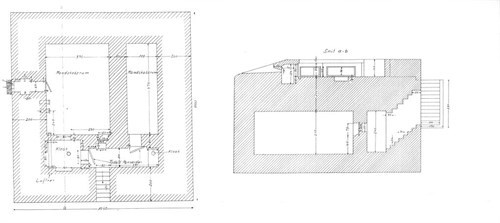
Ground plan and sectional drawing of anti-aircraft bunker of the type Regelbau Fl 242. Measured by the Coastal Defense 1947.
Bunker for the 3.7 cm anti-aircraft gun. In late summer 1941, four bunkers were built to protect the 38 cm battery against attacks from low-flying aircraft.
The walls of the bunker are only 40 cm thick, which is why the bunker went out of use in 1943, when new bomb-proof bunkers with 2 m thick walls were built. After that, the bunker was probably used for housing and ammunition storage.
The anti-aircraft gun was located on the concrete slab in front of the bunker entrance. In the bunker's crew room there was room for 10 men. accommodate 1.
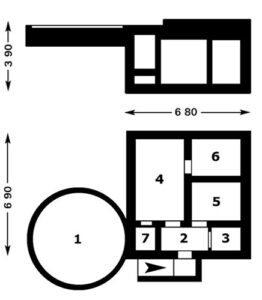
1. Gun position
2. Entrance
3. Toilet
4. Crew compartment
5. Ammunition room
6. Ventilation
7. Telephone
Drawing: Rudi Rolf
Machine gun position, "ring position", of the Bauform 58c type. In 1943-44, 20 bunkers of this type were built to defend the outer edges of the battery.
The small bunker consists of a manhole from which the machine gun was fired and a small room for storing ammunition.
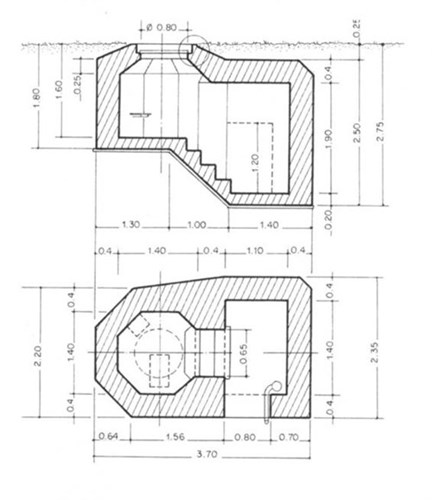
The bunker was excavated in October 2006.
Crew bunkers of the type Regelbau 668 (building no. 1234, cast on April 20, 1994 and no. 1249, cast on October 5, 1944). They were to house part of the crew that was to protect the battery from attacks by enemy foot soldiers.
The bunker had bunks for six men. The bunker was equipped with a tiled stove and a hand-operated ventilation system.
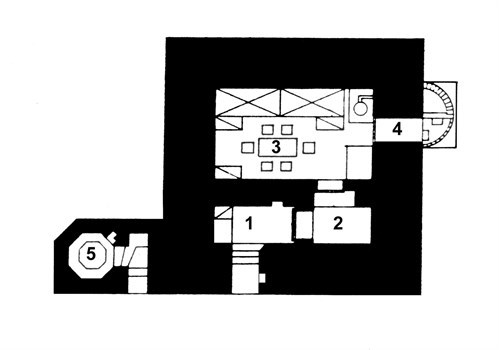
1. Entrance
2. Gas lock
3. Crew compartment
4. Emergency exit, filled with ral/sand
5. Machine gun and observation position
This small and simple bunker was part of the museum bunker's close defense. The bunker would provide cover for the machine gun crew during bombardment while firing from an open position nearby.
The room itself measures 97 x 154 cm. The ceiling thickness is 13 cm, while the wall thickness is approximately 25 cm.
The bunker was probably built in 1942 and is not a standard bunker.
Small bunker, "ring position" type Bauform 69 for 8 cm footing mortar. (Since the map was made, two more have been uncovered).
The ring structure was probably built in the summer or fall of 1943. Approximately 40 m was used for the concrete pour3 of reinforced concrete. The bunker has 30-centimeter-thick ceilings and walls.
The bunker consists of two ring positions - a large one for the mortar and a small one for observation/machine gun - an ammunition room and entrance.
The bunker was part of a platoon with three German 8 cm foot mortars located in this part of the 38 cm battery. There were two such platoons with 8 cm mortars in the central part of the 38 cm battery.
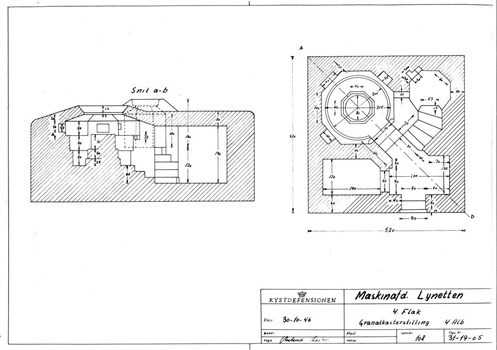
Ground plan and sectional drawing of ring position for mortar, Bauform 69. Measurement of the coastal defense, 1948.
Small observation bunker located behind the museum bunker.
The bunker has a footprint of approximately 2 x 2 m and 25-30 cm thick walls. In the front of the bunker is an observation slit.
The exact purpose of the bunker is unknown, but it is believed to have contained a spotting scope.
Small concrete bunker that would take command of the 38 cm battery in case the large fire control bunker was disabled during combat.
Pouring the concrete for the bunker, whose ceiling and walls are 80 cm thick, required 120 m3 of reinforced concrete. It is unclear when the bunker was built, but it was likely not before the summer of 1942.
The bunker consists of two rooms, both of which have an observation slit. The small bunker has not had room for much equipment.
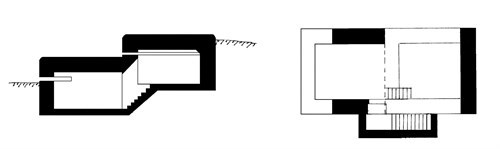
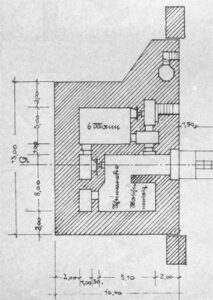
Section and floor plan of reserve fire management bunker. Jens Andersen 1985.
"The Station" - starting point for the museum train tour.
Hanstholm's only railway station!
The museum train runs every day in June-August and in week 42 during museum opening hours or by appointment.
See the timetable here.
Price: 25 kr.
Children 0-2: years free of charge
Russian field gun constructed in 1931, the gun had the Russian designation "122 mm Pushka obr.1931 (122-31)". The gun has a weight of 7,100 kg in position and had a range of 20,870 m.
In the early years of the war against Russia, a large number of these efficient and robust guns, along with large amounts of ammunition, fell into German hands.
Our cannon, which bears the number "613", was produced in 1939-40: the year "1939" is stamped on the cannon itself, while "1940" can be seen on the lower wheel axle. The gun arrived in Denmark in January 1944, where it was installed in one of the nine coastal batteries with this type of gun.
After the Liberation, the gun was rendered useless by cutting through the breech, chamber, barrel and recoil brakes with a cutting torch.
Until 1958, the cannon stood as a landmark in the Artillery Camp in Esbjerg. When the camp was closed down, the cannon was placed on a former German airfield, where it was rediscovered in the mid-1980s. It was then taken to Varde Barracks, where it was recovered in late summer 2003. In 2004, the cannon was donated to the museum.
Regelbau 501 crew bunker with 2-meter thick walls and ceilings.
The bunker had the German building number 1115 and was completed on September 16, 1942. 450 m3 of reinforced concrete was used for the casting. In the summer of 1943, a machine gun position (ring position) was added to the right of the entrance.
In addition to the entrance and gas lock, the crew bunker consisted of a single room with bunks for 10 men. The crew room was heated by a tiled stove and was also equipped with a periscope and emergency exit.
In the fall of 1942, five bunkers of this type were built in the 38 cm battery as part of the reinforcement of the battery's close defense.
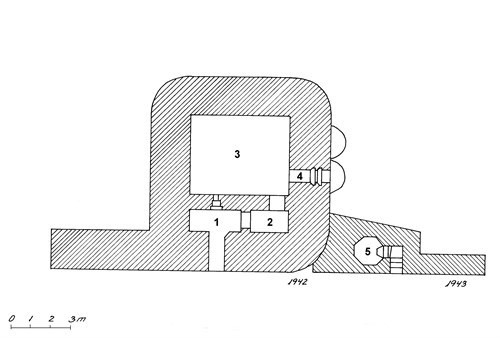
- Entrance
- Gas lock
- Crew compartment
- Emergency exit, filled with ral/sand
The ammunition track was built because the ammunition for the 38 cm guns was too heavy to be carried around on a sack truck. Therefore, an approximately 4.3 km long narrow-gauge track was constructed within the battery area. Shells and powder charges were transported by small diesel locomotives to the four gun positions from six large ammunition bunkers located further back in the terrain.
See the museum train timetable.
In the museum terrain, part of the old ammunition track has been restored. With the museum train you can take a trip through the battery and pass through one of the large ammunition bunkers and one of the bunkers for the 38 cm cannon. The trip is just over 1 km long and takes about 10 minutes.
10.5 cm S.K.C/32. Combined anti-ship and anti-aircraft gun originally designed for use on light naval units, but also widely used in coastal defense.
The gun had a maximum range of 15,175 m and could fire up to 16 shots per minute. The shells weighed 15 kg.
In 1945, 16 cannons of this type were set up at Hanstholm.
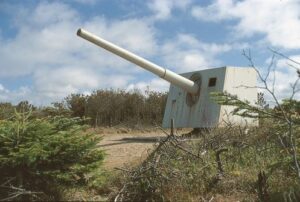
German ship cannon of the type 15 cm S.K.C/28.
The cannon type was installed in many different types of lavettes. This gun is in a coastal artillery launcher model 1936, Küst MPL C/36. The gun type was designed by the German company Rheinmetall-Borsig, but this gun was produced at the Skoda factories in the Czech Republic and has production number 1457. This gun was installed in the fall of 1944 in a German coastal battery at Hesbjerg near Gilleleje in North Zealand.
FACTS
Model year: 1928
Weight of cannon in position: 19,661 kg
Length of gun barrel: 8.2 m
Range: 23,500 m.
Shell weight: 45 kg
Muzzle velocity: 875 m/s
Rate of fire: 6 shots per minute
15 cm cannon on Fynshoved, photographed in August 1945.
German ship cannon of the type 38 cm S.K.C/34. The gun type was designed for the German battleships of the "Bismarck" class.
The gun barrel is of the same type as the ones in the museum bunker.
Until May 2005, this gun barrel was located in the courtyard of the Tøjhus Museum in Copenhagen. The gun barrel should have been mounted in the German battery "Tirpitz" at Oksby, near Blåvand. However, the cannons were never mounted, so in May 1945, the gun barrels were stored at a storage site at Guldager Station near Esbjerg. In 1947, the gun barrels were transported to Copenhagen.
Originally, the gun tube had been manufactured to rearm the German battleship "Gneisenau", which had previously been equipped with 28 cm guns. However, the refitting was abandoned in February 1943 after the ship was severely damaged during an Allied bombing raid. Instead, the guns were used for coastal defense.
The gun barrel has the number "89" and was manufactured at the Krupp factory in Essen in 1943.
The second-easternmost of the 38 cm battery's four gun bunkers, gun no. 2, is located approximately 300 m east of the museum bunker. The bunker is identical to the museum bunker.
The bunker's gun emplacement was filled with earth in 1971. However, both the crew and ammunition parts of the bunker are still accessible.
In the ammunition rooms, you can see well-preserved paintings of grenades and powder casings above the ammunition locks.
Don't forget your flashlight!
The museum bunker has a total area of approximately 2500 m2, making it one of the largest bunkers the Germans built in Denmark. In the center of the museum bunker stood one of the four 38 cm cannons that made up the German coastal battery.
The battery could launch its shells at a distance of 55 km. Together with a similar battery at Kristiansand in Norway, on the other side of the Skagerrak, the battery in Hanstholm would block the approximately 120 km wide waters between Denmark and Norway.
The bunker consists of three main parts: ammunition room, gun bay and crew and technical section.
The big gun has not been preserved, but some of the bunker's rooms have been restored and returned to their original appearance with original equipment. In the other rooms there are exhibitions that shed light on different topics.
The westernmost of the 38 cm battery's four gun bunkers, gun no. 4, is located approximately 250 m northwest of the museum bunker.
The bunker is completely identical to the museum bunker but is a ruin with no lights or fixtures, so don't forget your flashlight when exploring!
The entrance to the bunker's ammunition room. Beware: in the summer months the museum train runs here!
Bunker type Regelbau S 468 for 38 cm ammunition.
The bunker had the German building number 1100 M5 and was completed on November 4, 1943. 5,130m3 of reinforced concrete was used to build the bunker. The bunker's ceiling and walls are 3.5 meters thick, making it the strongest type of bunker built in Hanstholm.
The bunker has two floors. Grenades were stored on the upper floor and the ammunition track runs through this part of the bunker. The powder charges were stored in the lower floor of the bunker, where there were also heating and ventilation systems to ensure a stable and good climate in the bunker.
The bunker had room for 232 rounds of 38 cm ammunition.
In the fall of 1943, four bunkers of this type were built in the battery.
Floor plan of the top floor of the ammunition bunker.
This simple bunker was probably the depot for the 38 cm battery's emergency rations and was probably built in 1941.
There was no kitchen in the four gun bunkers. Food for the battery's crew was prepared and partly consumed in a large canteen further up the road - now a district heating center. In the event of a battle, it was impossible to leave the battery and emergency rations were needed.
Power bunker to supply the 38 cm battery with power in case the supply from the civilian grid was interrupted.
The bunker had the German construction number 1100 MZ and has approximately 1 m thick walls and ceilings. Work on the bunker began in the summer of 1941, and in March 1942 it was largely completed, although in May 1942 the large generator had not yet been delivered.
The bunker contains an engine room, fuel room, cooling water room and ventilation room. In addition, the bunker contains a bedroom for three men.
In the bunker were two diesel generators, a large 200 hp and a smaller 56 hp - equivalent to the equipment in each of the four gun bunkers.
Floor plan, 1947.
Machine gun bunker, so-called "F-Stand", built in June 1944.
From the firing slit, the road leading up from the beach could be fired upon, thus protecting the battery from attack from this side. The sea-facing wall of the bunker is particularly thick and is extended like a trunk so that the firing slit was covered against fire from this side.
The only room in the bunker had a stove and bunk space for two men.
The 38 cm guns were controlled from the large fire control bunker located on the edge of Holmen, about 250 meters northeast of the museum bunker.
The bunker with the German construction number 1100 L has 1-2 m thick walls and ceilings. Work on the bunker began in February 1941, and in the second half of May the bunker was completed. However, the large bunker was not fully furnished until December 1941. Until then, the battery's firing was directed from a temporary fire control station, which was demolished at the same time as the large bunker was taken into use.
Sectional drawing of the front part of the fire control bunker with dome with rangefinder and dome with periscope.
The two-storey bunker had a 10.5 m long rangefinder on the roof of a large, rotating armored dome. On the top floor of the bunker was a calculation room where bearings and range measurements were converted into shot data. The lower floor of the bunker contained living quarters for the crew, showers and toilets.
The bunker is still accessible, but is separated from the museum area by Kaj Lindberggade, which was built in the 1960s. As the bunker is on two floors, great care should be taken when traveling in it.
A Regelbau L/411A floodlight garage for a 60 cm floodlight. The bunker was built in late summer 1943.
The searchlight was used for night air raids. The searchlight had to identify the aircraft for the three positions with 2 cm anti-aircraft guns that were located around the searchlight position. When there was an air raid, the searchlight was driven out of the garage and up the concrete track to a position up on the slope.
The bunker's garage room housed the searchlight and its diesel generator, which produced power for the searchlight. The bunker's crew room contained bunks for 6 men as well as a tiled stove and a hand-operated ventilation system.
Bunker of type Regelbau Fl. 242 for a 2.0 cm anti-aircraft gun.
The bunker had the German building number 1116 and was completed on June 4, 1943. 570 m3 of reinforced concrete was used to build the bunker. The bunker ceiling and walls are 2 m thick.
The bunker consists of an open breech on the roof where the anti-aircraft gun was set up. In the bunker there is a crew room with room for six men and an ammunition room.
The bunker was part of a platoon with a total of three anti-aircraft guns to protect 38 cm gun no. 3 - the current museum bunker - against attacks from low-flying aircraft. Each of the four 38 cm guns was protected by such a platoon of light anti-aircraft guns.
Ground plan and sectional drawing of anti-aircraft bunker of the type Regelbau Fl 242. Measured by the Coastal Defense 1947.
Bunker of type Regelbau Fl. 242 for a 2.0 cm anti-aircraft gun.
The bunker had the German building number 1135 and was completed on June 25, 1943. 570 m3 of reinforced concrete was used to build the bunker. The bunker ceiling and walls are 2 m thick.
The bunker consists of an open breech on the roof where the anti-aircraft gun was set up. In the bunker there is a crew room with room for six men and an ammunition room.
The bunker was part of a platoon with a total of three anti-aircraft guns to protect 38 cm gun no. 3 - the current museum bunker - against attacks from low-flying aircraft. Each of the four 38 cm guns was protected by such a platoon of light anti-aircraft guns.
Ground plan and sectional drawing of anti-aircraft bunker of the type Regelbau Fl 242. Measured by the Coastal Defense 1947.
Bunker of type Regelbau Fl. 242 for a 2.0 cm anti-aircraft gun.
The bunker had the German building number 1134 and was completed on April 6, 1943. 570 m3 of reinforced concrete was used to build the bunker. The bunker ceiling and walls are 2 m thick.
The bunker consists of an open breech on the roof where the anti-aircraft gun was set up. In the bunker there is a crew room with room for six men and an ammunition room.
The bunker was part of a platoon with a total of three anti-aircraft guns to protect 38 cm gun no. 3 - the current museum bunker - against attacks from low-flying aircraft. Each of the four 38 cm guns was protected by such a platoon of light anti-aircraft guns.
Ground plan and sectional drawing of anti-aircraft bunker of the type Regelbau Fl 242. Measured by the Coastal Defense 1947.
Bunker for the 3.7 cm anti-aircraft gun. In late summer 1941, four bunkers were built to protect the 38 cm battery against attacks from low-flying aircraft.
The walls of the bunker are only 40 cm thick, which is why the bunker went out of use in 1943, when new bomb-proof bunkers with 2 m thick walls were built. After that, the bunker was probably used for housing and ammunition storage.
The anti-aircraft gun was located on the concrete slab in front of the bunker entrance. In the bunker's crew room there was room for 10 men. accommodate 1.
1. Gun position
2. Entrance
3. Toilet
4. Crew compartment
5. Ammunition room
6. Ventilation
7. Telephone
Drawing: Rudi Rolf
Machine gun position, "ring position", of the Bauform 58c type. In 1943-44, 20 bunkers of this type were built to defend the outer edges of the battery.
The small bunker consists of a manhole from which the machine gun was fired and a small room for storing ammunition.
The bunker was excavated in October 2006.
Crew bunkers of the type Regelbau 668 (building no. 1234, cast on April 20, 1994 and no. 1249, cast on October 5, 1944). They were to house part of the crew that was to protect the battery from attacks by enemy foot soldiers.
The bunker had bunks for six men. The bunker was equipped with a tiled stove and a hand-operated ventilation system.
1. Entrance
2. Gas lock
3. Crew compartment
4. Emergency exit, filled with ral/sand
5. Machine gun and observation position
This small and simple bunker was part of the museum bunker's close defense. The bunker would provide cover for the machine gun crew during bombardment while firing from an open position nearby.
The room itself measures 97 x 154 cm. The ceiling thickness is 13 cm, while the wall thickness is approximately 25 cm.
The bunker was probably built in 1942 and is not a standard bunker.
Small bunker, "ring position" type Bauform 69 for 8 cm footing mortar. (Since the map was made, two more have been uncovered).
The ring was probably built in the summer or fall of 1943. Approximately 40 m3 of reinforced concrete was used for the casting. The bunker has 30 cm thick ceilings and walls.
The bunker consists of two ring positions - a large one for the mortar and a small one for observation/machine gun - an ammunition room and entrance.
The bunker was part of a platoon with three German 8 cm foot mortars located in this part of the 38 cm battery. There were two such platoons with 8 cm mortars in the central part of the 38 cm battery.
Ground plan and sectional drawing of ring position for mortar, Bauform 69. Measurement of the coastal defense, 1948.
Small observation bunker located behind the museum bunker.
The bunker has a footprint of approximately 2 x 2 m and 25-30 cm thick walls. In the front of the bunker is an observation slit.
The exact purpose of the bunker is unknown, but it is believed to have contained a spotting scope.
Small concrete bunker that would take command of the 38 cm battery in case the large fire control bunker was disabled during combat.
120 m3 of reinforced concrete was used to cast the bunker, whose ceiling and walls are 80 cm thick. It is not known when the bunker was built, but it is unlikely to have been built before the summer of 1942.
The bunker consists of two rooms, both of which have an observation slit. The small bunker has not had room for much equipment.
Section and floor plan of reserve fire management bunker. Jens Andersen 1985.
"The Station" - starting point for the museum train tour.
Hanstholm's only railway station!
The museum train runs every day in June-August and in week 42 during museum opening hours or by appointment.
See the timetable here.
Price: 25 kr.
Children 0-2: years free of charge
Russian field gun constructed in 1931, the gun had the Russian designation "122 mm Pushka obr.1931 (122-31)". The gun has a weight of 7,100 kg in position and had a range of 20,870 m.
In the early years of the war against Russia, a large number of these efficient and robust guns, along with large amounts of ammunition, fell into German hands.
Our cannon, which bears the number "613", was produced in 1939-40: the year "1939" is stamped on the cannon itself, while "1940" can be seen on the lower wheel axle. The gun arrived in Denmark in January 1944, where it was installed in one of the nine coastal batteries with this type of gun.
After the Liberation, the gun was rendered useless by cutting through the breech, chamber, barrel and recoil brakes with a cutting torch.
Until 1958, the cannon stood as a landmark in the Artillery Camp in Esbjerg. When the camp was closed down, the cannon was placed on a former German airfield, where it was rediscovered in the mid-1980s. It was then taken to Varde Barracks, where it was recovered in late summer 2003. In 2004, the cannon was donated to the museum.
Regelbau 501 crew bunker with 2-meter thick walls and ceilings.
The bunker had the German building number 1115 and was completed on September 16, 1942. 450 m3 of reinforced concrete was used for the casting. In the summer of 1943, a machine gun position (ring position) was added to the right of the entrance.
In addition to the entrance and gas lock, the crew bunker consisted of a single room with bunks for 10 men. The crew room was heated by a tiled stove and was also equipped with a periscope and emergency exit.
In the fall of 1942, five bunkers of this type were built in the 38 cm battery as part of the reinforcement of the battery's close defense.
- Entrance
- Gas lock
- Crew compartment
- Emergency exit, filled with ral/sand
ACTIVITIES
Playing with Chicken Rings
Playing with Chicken Rings
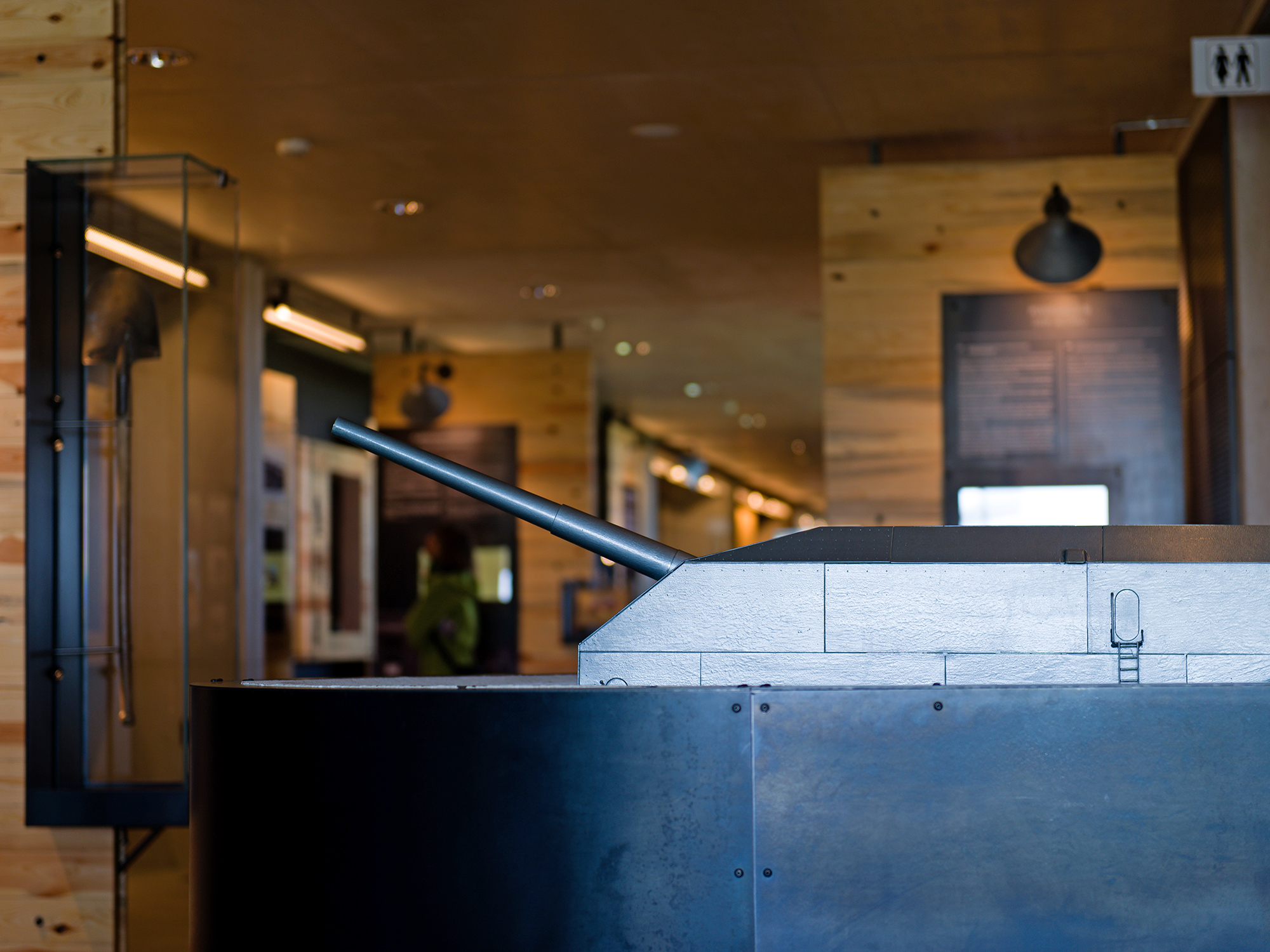
Night at the bunker museum
 20 min from Hanstholm
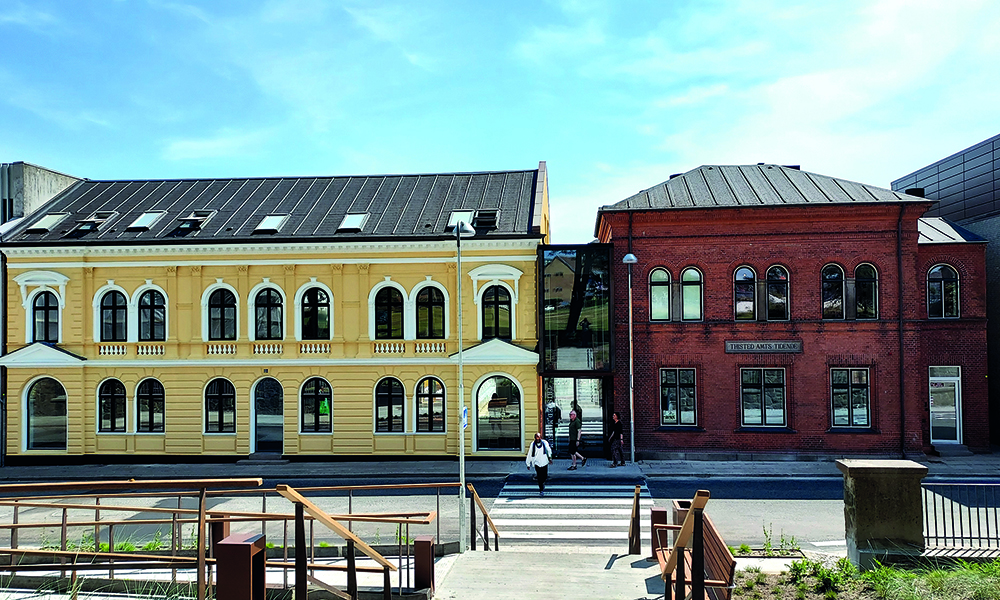
THISTED MUSEUM
"Thylands National Museum" is located in the center of Thisted. Here you can step into the world of the past and experience modern exhibitions on everything from spectacular archaeological finds, including the Kallerup find and a rune stone. Kallerupfundet and a rune stone, to stories about the new times with Thylejren and the arrival of surfers on the beaches. In the attic you'll find a special children's storage room.
Thisted Museum also offers the exhibition J.P. Jacobsen's World.
- ARCHAEOLOGY
- THE CITY
- J. P. JACOBSEN
- CHILD-FRIENDLY
- LOCAL IDENTITY
- MUSEUM STORE
 50 min from Hanstholm
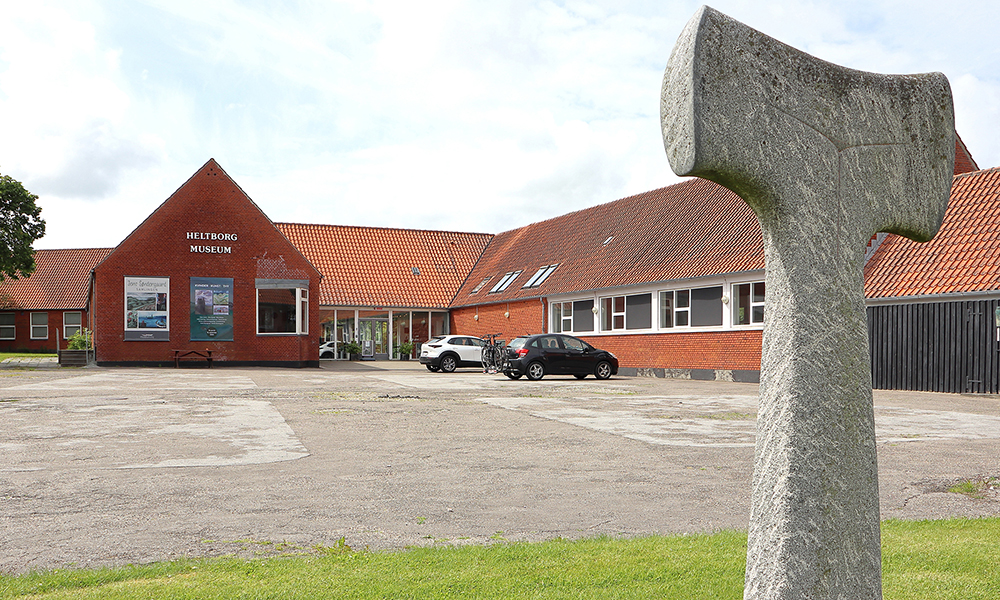
HELTBORG MUSEUM
Perhaps the most beautiful view of the Limfjord landscape? In Heltborg you can experience changing art exhibitions, including the museum's large collection of Jens Søndergaard paintings. You'll also find an exhibition about agricultural tools in the time before the tractor.
During the summer holidays there are children's activities and live entertainment in the Iron Age courtyard behind the museum.
- ART COLLECTION
- SPECIAL EXHIBITIONS
- IRON AGE FARM
- MUSEUM STORE
- DEVELOPMENT
- BEFORE THE TRACTOR
 20 min from Hanstholm
VORUPØR MUSEUM
In the boat builder's old house, you'll find the coziest museum in Thy. In the old boatyard you can see a traditional clinker-built boat and a range of tools from fishing, boat building and rescue services. Inside the house, we tell stories about the people on the coast and their relationship with the berries of the dune heath. What is the taste of Thy?
Vorupør Museum offers many activities for children, including building your own boat in the workshop.
- COASTAL CULTURE
- WORKSHOP
- CHILD-FRIENDLY
- FOOD CULTURE
- THE TASTE OF THY
- HYGGE.